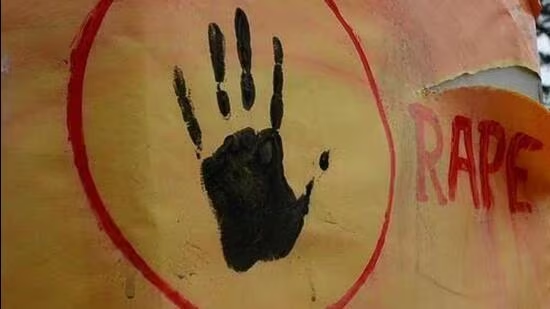
rape

Rape Scars

1 min read

When the girl child is viewed as a lesser mortal and children are violated with alarming frequency, it is time to concede that the rot in society runs deep. While incidents of child abuse, rape and murder mount across the country, the nation refuses to rise in anger. Recently, a teenage girl was gang-raped by robbers in the presence of her family near Pakpattan; four armed men on motorcycles intercepted the victim’s car, snatched their car keys, stole cash, gold jewellery, and mobiles, and took the girl to the roadside maize fields where she was tortured and gang-raped by two criminals, while the other two held her family hostage. Clearly, we are at the threshold of a rape crisis and the reason for it is our flimsy response; it aborts justice by perpetuating stigmatisation and victim-blaming.

The government and law enforcement have failed to protect children from sexual violence. More disgraceful is the fact that, despite improved awareness due to more reported cases, the attitude adopted by the criminal justice system towards rape cases remains problematic. The ruling elite is unshaken by data from Sahil — 11 children were abused daily in 2023, and a gender divide analysis of the statistics revealed that out of the total reported cases, 53pc were girl victims and 47pc boys.

Moreover, in cultures where sexual crimes are treated as taboo, survivors are deprived of essential mental and medical support. Thus, holistic healing is as vital as justice for a safe society. Silence and scars create anti-social individuals who are unable to escape the cycle of crime. Reparation completes justice for the violated, along with preventive mechanisms in rural and urban areas that align with international criteria — CCTV monitoring, rapid response units, heightened patrolling, women personnel, and robust care systems for all survivors. Lawmakers cannot tread wearily around the issue; they must tackle gender disparity, listen to victims, and punish felons.

(Editorial) Published in Dawn, September 25th, 2024

school privatisation protest
Previous Story

Teachers Protest Outsourcing Of Schools

Next Story

250,000 Die Annually Due To Drug Addiction

Latest from Blog

Govt to Replace Textbooks in Schools to Suit Newly-introduced Semester System

PESHAWAR: The Khyber Pakhtunkhwa Textbook Board plans to change the textbooks for each grade in line with the semester system recently introduced in public and private schools. “The decision to change the course books of each grade has been taken after the implementation of semester system in schools by elementary…

Teenager Killed 19 Days Ago Laid to Rest as Family Ends Sit-in

KARACHI: Nineteen days after he was shot dead during a house robbery in Manghopir, family and relatives of 17-year-old Rosham Hussain ended their protest sit-in outside the Manghopir police station and buried their loved one in a local graveyard on Sep 27. His funeral prayer was offered at a ground near…

Where we Fail in Education

In my classroom, I encounter students who are more concerned with securing marks than acquiring knowledge. Some have learned to memorise answers, while others believe grades could be secured through influence or money. Parents, too, often measure educational success by examination scores and admission to prestigious university programmes. The result…

APTA Seeks Early Regularisation of Primary Teachers

PESHAWAR: All Primary Teachers Association (APTA) Khyber Pakhtunkhwa president Azizullah Khan has urged the provincial government to complete the regularisation of 14,000 teachers at the earliest and implement its decision to upgrade primary school teachers. Talking to reporters here on Friday, he said a separate directorate for primary education was…

Reducing the burden

PAKISTAN’S students do not need voluminous textbooks especially in the early stages; they need better learning. The Punjab government’s decision to revise the curriculum from pre-primary to Grade 5, reduce textbook volume by 25pc, and shift students away from rote learning is therefore a welcome step. The current education system…
Go toTop